The Software Engineer’s job doesn’t stop at the commit followed by the push. On the contrary, that precise moment is where everything begins: once the code is out, it comes to life in an environment we rarely master as well as our text editor: production. That’s where the code meets real traffic, network failures, load spikes, temperamental dependencies, and the thousand surprises of a distributed world.
This principle, often overlooked, deserves a pause. “Shipping to prod is good. Surviving in prod is better.” Deploying is just one step; the real challenge is keeping an application available, performant, and understandable over time. Here are the main axes that distinguish an application that’s merely deployed from one that’s truly Enterprise-Ready.
Mastering your platform
Before any tool or any pattern, you need a deep understanding of the inner workings of the platform you’re building on. In the case of Node.js, that means knowing the Event Loop model, the asynchronous patterns, the distinction between single-threaded and multi-threaded execution, or the difference between I/O operations and CPU-bound operations.
This knowledge isn’t an academic luxury: it directly conditions performance and stability in production. Knowing that a CPU-bound task will block the Event Loop, understanding how workers or threads behave under load, anticipating contention points: these are the things that make the difference between an application that holds up and one that collapses at the first traffic spike.
Choosing the right communication channels
An application in production rarely communicates alone: it talks to other services, databases, message queues. The choice of communication protocol isn’t neutral. HTTP, GraphQL, gRPC, WebSockets: each has its use cases, its strengths, and its trade-offs.
A synchronous request/response exchange, a real-time bidirectional stream, a low-latency inter-service call, an API exposed to heterogeneous clients: these needs don’t call for the same technical answer. Choosing your communication mode well is a powerful lever for performance and robustness: a bad choice is paid for in latency, coupling, and operational complexity.
Scalability and infrastructure
An Enterprise-Ready application must be able to absorb increasing load without a rewrite. Scaling happens at several levels.
At the infrastructure level, reverse proxies like HAProxy or NGINX handle load balancing, compression, and TLS termination. Distributed caches like Redis or Memcached relieve the services and speed up responses.
But scalability isn’t decreed at the infra level alone: it’s designed from the application itself. Designing stateless services means giving yourself the ability to start or stop them on the fly, to replicate them horizontally, and to let an orchestrator like Kubernetes manage their lifecycle without friction. An application that retains local state becomes a bottleneck; a stateless application becomes a fungible resource you can multiply at will.
Application lifecycle
Going to production has its own lifecycle, from build to deployment, and it deserves as much care as the code itself.
It starts with building an image optimized for the service, designed to be lightweight, reproducible, and secure. Then comes deployment, ideally orchestrated from a CI/CD pipeline that guarantees consistency and traceability.
Once deployed, the application must behave as a good citizen of its environment: allow graceful shutdowns so as not to abruptly cut off in-flight requests, avoid memory leaks that eventually kill the process, and properly handle exceptions rather than letting uncaught errors bring the service down. These details, invisible in development, become critical the moment an orchestrator starts and stops instances continuously.
Observability
You can’t operate what you can’t see. Observability is what turns a black box into a comprehensible system. It rests on several complementary pillars:
- Logging: the structured trace of what’s happening, indispensable for diagnosis.
- Distributed Tracing: following a request across the multiple services it traverses, to reconstruct a journey and locate a bottleneck.
- Metrics: the quantitative indicators (latency, throughput, error rate, resource consumption) that give the system’s pulse.
- Alerting: the ability to be notified before an incident becomes a crisis.
- Dashboarding: the visual perspective that lets you understand trends and correlations.
Without this stack, debugging in production is a matter of divination. With it, you move from a reactive posture to a proactive one.
Security
Security isn’t a layer you add at the end: it’s thought through end to end, at the application level as much as the infrastructure level.
That goes through rigorous dependency management (monitoring known vulnerabilities, keeping versions up to date) and through sound secrets management, which should never end up in plaintext in the code or the logs. On top of that come the classic best practices: principle of least privilege, input validation, configuration hardening. These are all reflexes that reduce the attack surface of an exposed system.
Resilience, resilience, resilience
If there were only one axis to remember, it would be this one. Production is an unpredictable and chaotic world: networks go down, third-party services slow down, dependencies fail at the worst possible moment. Resilience patterns are what allow an application to survive and to stay available in spite of everything.
Retries, timeouts, circuit breakers, bulkheads, graceful degradation: these patterns are not optional for anyone aiming at serious production. They form the safety net that prevents an isolated failure from cascading in a domino effect all the way to a complete collapse. This is precisely what separates an application that “works on my machine” from one that holds up under real conditions.
A gateway to Enterprise-Ready
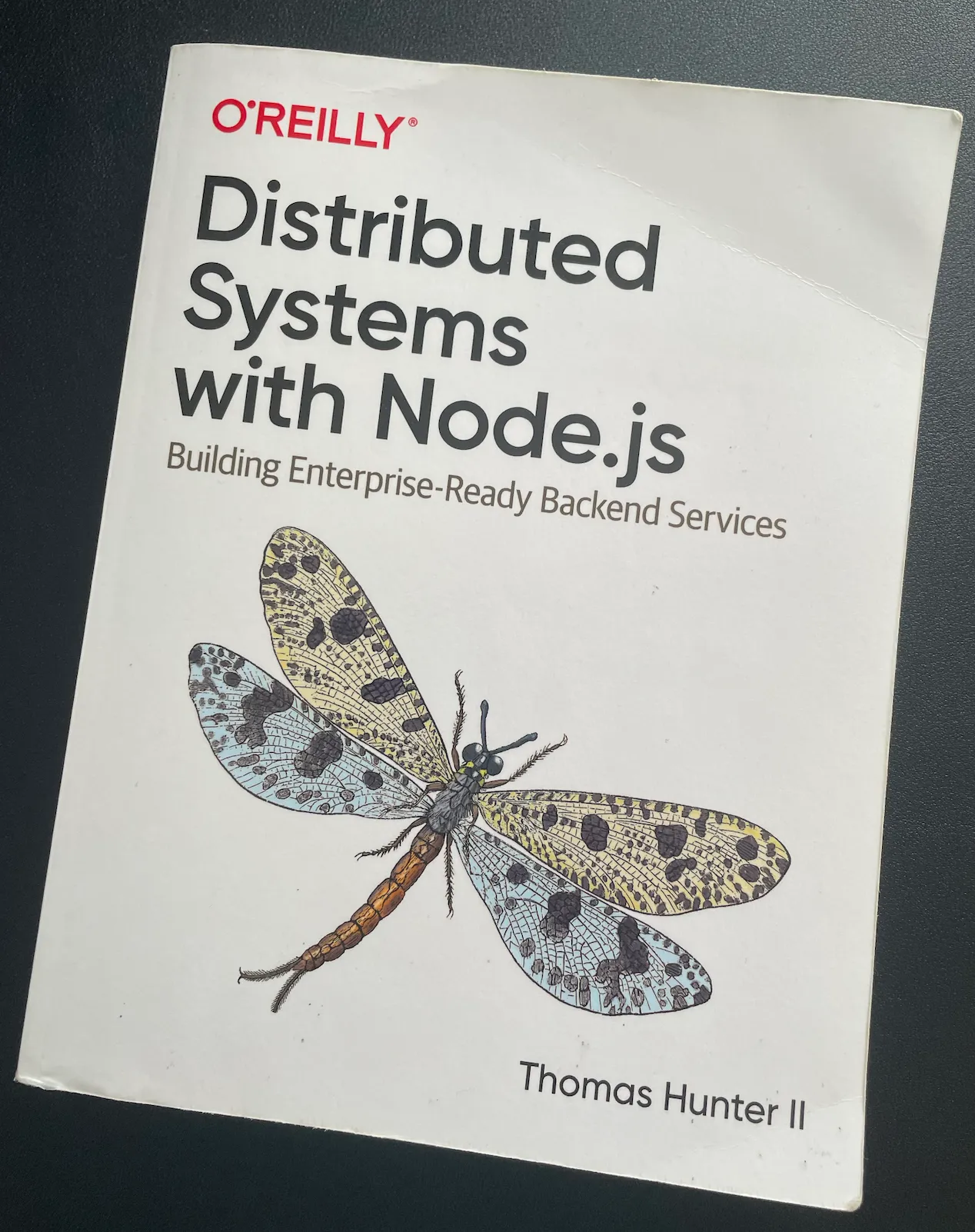
Most of these topics are beautifully covered in Distributed Systems with Node.js by Thomas Hunter II. It’s an excellent gateway into the world of Enterprise-Ready applications. Node.js serves as the example there, but the bulk of the concepts is transposable to any ecosystem: the principles of communication, scalability, observability, and resilience are universal.
My own copy bears the scars. Its worn-out state attests to the particular treatment I’ve given it over the past few years: rereads, annotations, back-and-forths between chapters as incidents and architectures to design came up.
Conclusion
Deploying is just a beginning. A truly production-ready application is recognized by its ability to live over time: fine mastery of its platform, sound communication choices, scalability designed in from the start, a clean lifecycle, end-to-end observability, built-in security, and rock-solid resilience.
None of these axes is sufficient on its own, and none can be improvised after the fact. Internalizing them from the design stage is how you give yourself the means not only to ship to prod, but above all to survive there.