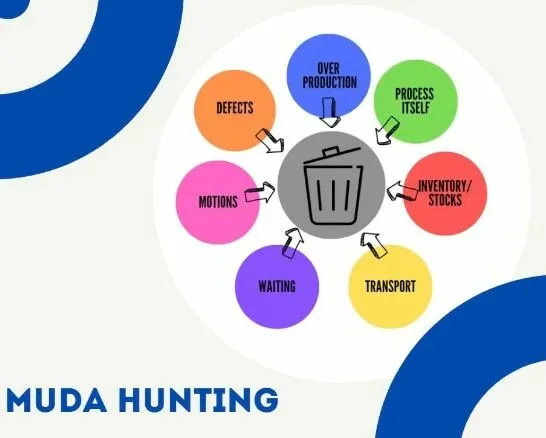
Across every industry and every trade, waste wears a thousand faces. Lean Management, inherited from the Toyota Production System, gives it a single name: Muda. Behind this Japanese word hides a simple but fiercely operational idea: anything that consumes resources without producing value is, by definition, waste to be hunted down.
By “waste,” we mean precisely an activity that is not necessary to produce value, yet still consumes resources: time, money, energy, the availability of teams. Muda is therefore not just a factory concern: it describes an automotive assembly line just as well as a software engineering team piling up tickets, meetings, and rework.
In a previous article, I discussed the Gemba Walk and its ability to reveal problems directly from the field, where value is created. That is precisely one of its strengths: it lets you flush out these Mudas, which are most of the time symptomatic of much deeper problems. A visible piece of waste almost always hides a root cause that itself deserves a thorough analysis.
We generally distinguish eight categories of Muda, which you can memorize thanks to the acronym TIM WOOD, to which an eighth waste, Talent, was added after the fact.
T: Transportation
This waste refers to the excessive movement and transport of the produced item. Take a restaurant: the “item” is the plate holding the dish. If, for lack of organization, it has to make pointless round trips between the various kitchen stations before reaching the dining room, every superfluous journey is a transportation Muda.
In software engineering, we find the same pattern as soon as a piece of data or a deliverable passes through too many intermediaries: endless handoffs between teams, an artifact traveling from one environment to another without need, or information circulating from department to department before reaching the one who actually needs it.
I: Inventory
This waste corresponds to the excessive storage of items intended for sale. Dormant stock ties up capital, generates storage costs, and exposes you to the risk of the product expiring or deteriorating.
On the software side, “stock” takes the form of work started but not delivered: features developed and waiting in a branch, code awaiting review, or increments completed but blocked before going to production. All this work in progress is frozen capital that generates no value until it reaches the user.
M: Motion
The motion Muda refers to the useless or inefficient movements performed by the person or equipment producing the item: a poorly arranged workstation, a lack of ergonomics, unsuitable tooling that forces you to multiply manipulations.
For a technical team, these are all the daily micro-frictions: navigating between poorly integrated tools, manually repeating operations that could be automated, or constantly searching for information that is badly filed. Each superfluous gesture, taken in isolation, seems harmless, but their accumulation erodes productivity.
W: Waiting
This waste refers to the idleness of people or equipment waiting to be processed, because of a blocking earlier task. Value does not move forward: it sits in line.
This is probably the Muda most familiar to engineering teams. We wait for a code review, we wait for the end of a continuous integration pipeline, we wait for an approval, we wait for a dependency to become available. Meanwhile, work piles up upstream and the people downstream run at half speed.
O: Overprocessing
Overprocessing refers to an activity that adds no more value than the initial processing: redundant steps, useless procedures, a refinement that no one asked for.
In development, this covers over-engineering: premature abstractions, speculative generalizations for hypothetical needs, sprawling documentation that no one will read, or validation processes wildly disproportionate to the actual stakes. Doing more than necessary is still waste, even when it’s done with the best intentions.
O: Overproduction
Overproduction refers to producing too much relative to demand or to the processing capacity of the next step. In the Lean model, it is one of the most toxic forms of waste, because it often feeds several others (inventory, waiting, defects).
The example is crystal clear in engineering: a Product Owner filling the backlog with dozens of tickets, which will become obsolete over time, while the developers can only handle one at a time. We produce work faster than it can be consumed, and the surplus ends up going stale without ever creating value.
D: Defects
This waste refers to the production of defective items, in other words, non-quality. Its consequences are paid in cash: customer dissatisfaction, rework, and support to set things right.
In our trade, defects have a well-known name: bugs. Every bug fix is work that creates no new value: it merely repairs value we thought was already delivered. Add to that regressions, production incidents, and all the support effort mobilized to absorb the failures. Non-quality doesn’t just cost a lot: it diverts the team’s energy away from what really matters.
T: Talent
The eighth and final Muda, added after the original acronym was created, the waste of talent refers to the poor use of people’s skills. This happens when someone is not allowed to fully leverage their know-how within the scope of their activities.
It is perhaps the most expensive waste in the long run, because it touches an organization’s most precious material: its people. An experienced engineer confined to repetitive tasks, an expertise ignored in the decisions that concern it, a relevant idea never heard, so many untapped potentials. Unlike the other Mudas, this one is not measured in stock or latency, but in frustration and disengagement.
Conclusion
The eight Mudas, Transportation, Inventory, Motion, Waiting, Overprocessing, Overproduction, Defects, and Talent, form a remarkably universal lens. Designed for the automotive industry, it applies just as well to a software team: transport of information, stock of undelivered work, waiting in front of a pipeline, bugs, overproduction of tickets.
The essential thing is to keep in mind that these forms of waste are almost never the cause of the problem: they are its symptom. Spotting them is only a starting point: the real value comes from the analysis that traces back to their origin. So, equipped with the acronym TIM WOOD as your compass: go hunt the Muda.