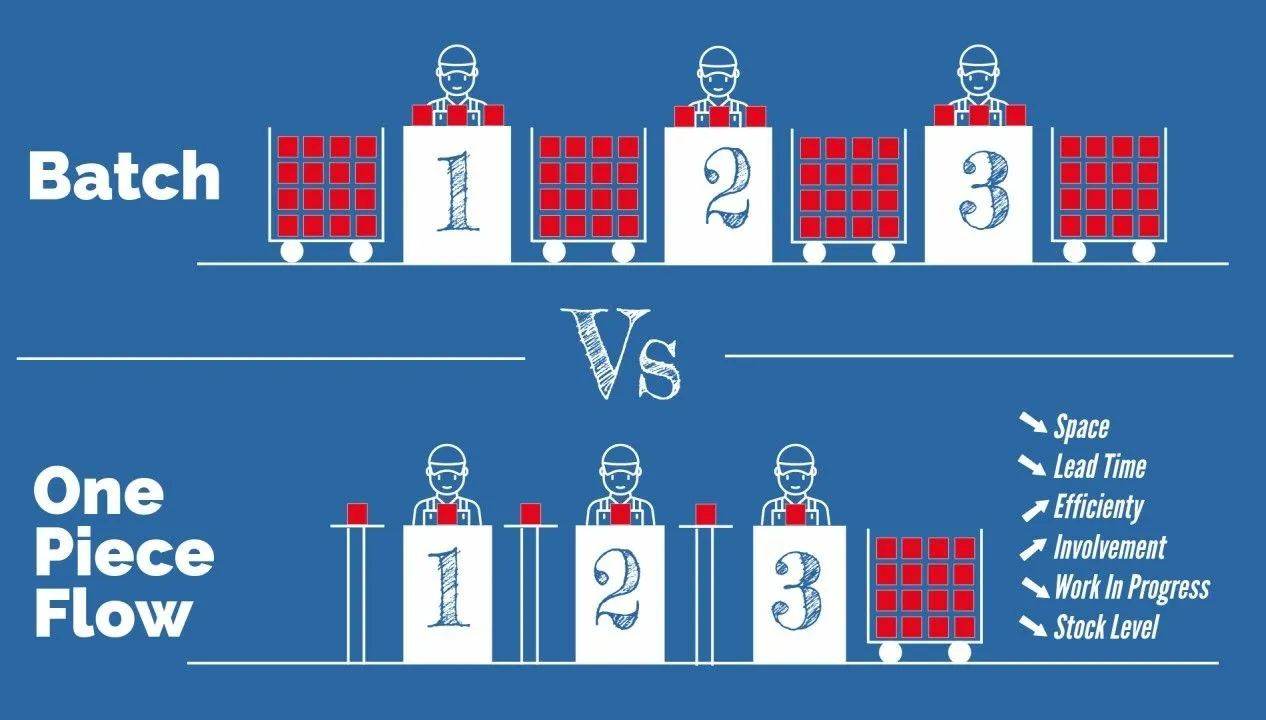
How much time actually passes between the moment a request enters your process and the moment the customer receives the result? That duration, the Lead Time, is one of the most telling indicators of the health of a production system, whether it’s a factory, a product team, or a software delivery pipeline. And the good news is that there’s a simple lever, drawn from Lean Management, to reduce it drastically: One-Piece Flow. Better yet, its effectiveness isn’t a matter of intuition: it can be proven mathematically.
One-Piece Flow: producing piece by piece rather than in batches
One-Piece Flow, or single-piece flow, is a production method from Lean Management in which units are made one at a time, from start to finish, instead of being processed and moved in whole batches from one step to the next.
The word “piece” should be understood here in the Lean sense: the deliverable unit of value. In a factory, it’s a product; in a software team, it can be a feature, a ticket, a story. The core idea stays the same: each piece moves through the various steps of the process without interruption, without piling up in an intermediate queue before moving on to the next step.
This paradigm shift, moving from batch processing to the continuous flow of a single piece, brings several direct gains:
- Less waste: in particular, it reduces intermediate storage, those piles of work-in-progress that sit idle between two workstations.
- A shorter cycle time: the reduction in Lead Time becomes mechanical, as we’ll see.
- More quality, responsiveness, and flexibility: a defect is detected immediately rather than at the end of an entire batch, and the system responds faster to change.
This is exactly what the classic comparison between the two modes of organization captures: in batch production, each station accumulates a reserve of pieces before passing it on, whereas One-Piece Flow circulates units one at a time. For equivalent output, the second approach reduces occupied space, inventory levels, work-in-progress… and Lead Time.
Little’s Law: the mathematical proof
The intuition is appealing, but we can go further and formally demonstrate why One-Piece Flow speeds up the process. The tool for that is Little’s Law, formulated in 1961 by the mathematician John Dutton Conant Little.
It establishes a remarkably simple relationship between three quantities of a system in steady state:
L = λ × W| Symbol | Name | Definition |
|---|---|---|
| L | Work In Progress (WIP) | The average number of items being processed in the system. |
| λ | Throughput | The average rate at which items arrive in (and leave) the system. |
| W | Lead Time | The average time an item spends in the system, from the start to the end of the process. |
What this equation tells us, read the right way, is fundamental: at constant throughput, reducing the number of items being processed proportionally decreases the time needed to complete them. Rearranging the formula, we indeed get:
W = L / λLead Time is therefore directly proportional to WIP. The less work in progress there is, the faster each unit moves through the system.
A worked example
Nothing beats putting numbers on it to make the point tangible. Let’s compare two organizations handling the same flow.
In a traditional, batch-based system. Imagine a high WIP, say 10 items in progress simultaneously, for a throughput of 1 item per hour. Little’s Law gives:
W = L / λ = 10 / 1 = 10 hoursEach item spends on average 10 hours in the system. In other words, even if an item only requires one hour of actual work, it will wait behind the other nine.
In a One-Piece Flow. Now let’s reduce the WIP to a single item, without changing the throughput at all (still 1 item per hour):
W = L / λ = 1 / 1 = 1 hourLead Time drops to 1 hour. For the same production capacity, we’ve divided the throughput time by ten, simply by limiting the number of things being processed at the same time.
Revisiting the benefits in light of the law
Armed with this demonstration, let’s revisit the advantages stated at the outset, this time backed by the formula.
Reducing WIP
One-Piece Flow limits, by design, the number of items being processed, often to a single piece at a time. And Little’s Law confirms it: if L decreases and λ stays constant, then W decreases by the same amount. Capping WIP isn’t an arbitrary constraint, it’s the most direct lever on Lead Time.
Lowering Lead Time
By reducing WIP, One-Piece Flow therefore mechanically shortens Lead Time. Fewer items in progress means each item advances more quickly through the process, which translates concretely into earlier and more frequent delivery to the customer.
Improving quality and responsiveness
With reduced work-in-progress, the team reacts faster to new requests, priority changes, and quality issues alike: there are fewer items waiting, and the process is easier to read and steer. A defect spotted on one piece doesn’t contaminate a whole batch already built up, you fix it before it spreads.
Conclusion
Reducing your Lead Time is no gamble: it’s a direct and predictable consequence of an organization that limits its work in progress. One-Piece Flow puts this logic into practice, and Little’s Law, L = λ × W, provides the mathematical proof. Fewer pieces processed simultaneously, at equal throughput, mechanically means a shorter throughput time.
Spreading One-Piece Flow is therefore far more than a production optimization: it’s a way to guarantee customer satisfaction by gaining responsiveness, flexibility, and quality. Before adding capacity or speeding up each station, start by asking the real question: how many things are you trying to move forward at the same time?